Flight of the Bumble Bee
The myth that bumble bees cannot fly arose from a dinner discussion between scientists.
According to John H. McMasters (Boeing) the story goes as follows: "A noted Swiss aerodynamicist was talking to a biologist at dinner. The biologist asked about the flight of bumble bees and the Swiss aerodynamicist, M. Sainte-Lague, did a "back-of-the-napkin" calculation, based on a rigid smooth wing of an airplane. What he found was insufficient lift and went off to find out the correct answer. In the meantime, the biologist put the word out that bees could not fly, presumably to show that nature was greater than engineering. The media picked up the story, but never printed a correction".
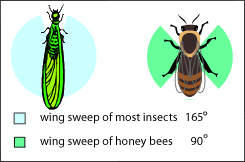
While incomplete scientific calculations at the time "proved" bumble bees aerodynamically incapable of flight, fly they do. Early researchers had no way to measure complex wing movements. It is now known most insects move their wings in long sweeping strokes (145-165°) at about 200 sweeps per second. Bees, however, use their wings in short strokes (appx. 90°) compensating with speed at about 240 sweeps per second. The buzzing sound of bees is created by the rapid wingbeats causing wind vibrations. The larger the bee, the slower the wingbeat, and the lower the pitch of the buzz. A result of it's small wing size to body ratio, is the honey bee has to work harder to fly than most insects. Still the honey bee is able not only to fly, but also get lift, hover, and evade predators, all while loaded with nectar and pollen.